Saturday, December 12, 2015

Fall Newsletter 2015

Sr. Kathy DeVico, Abbess, Redwoods Monastery
This Fall we featured Pope Francis' Encyclical, Laudato Si, in our newsletter.  It is timely because as you may know today the world has taken a united stand to address climate change in the Paris Agreement.  Many across the globe have been praying for this accord. The Global Catholic Climate Movement is one such organization that organized hours of prayers that visitors to the website could sign up for.  I think it is no small coincidence that this historic agreement happened on the Feast Day of Our Lady of Guadalupe who is the protector of all the poor.

Click here to read the comments and reactions to Laudato Si by the sisters and guests of Redwoods Abbey as we celebrate the Paris Agreement.


Sunday, November 1, 2015

Following the Monastic Path at Redwoods Monastery

The following article appeared in the Santa Rosa Diocese publication North Coast Catholic


There is a walking trail on the monastery’s property that winds along the bank of the Mattole River – up and down gentle ravines and through running creeks.  The river bank is fortified by the roots of giant redwoods and the water is crystal clear.  Occasionally we see fish – large steelhead and baby salmon – along with eels, ducks and river otter.  Then the trail swerves away from the river and enters an ancient grove of redwoods.  Some giants have fallen and are decomposing on the mountainside while new redwoods grow from out of old stumps.  Everywhere there are signs of regeneration – rebirth – and renewal.  Hope.  The Easter Mystery reflected in the very earth we live on.

Over 50 years ago, a group of sisters from the Cistercian Monastery of Nazareth in Brecht Belgium, left their homeland, their families, and monastery to travel to an unknown and rugged wilderness in the Lost Coast area of Southern Humboldt County California.  Most did not speak English or have any experience of American culture.  They were cloistered contemplatives nuns who embarked on their pioneer journey the very day Vatican II began.   The spirit of the Council marked the foundation of Redwoods Monastery with an eagerness and energy to adapt the Cistercian charism to yet another culture and age, while always maintaining fidelity to our Benedictine Cistercian heritage.

Today hospitality to guests is an important ministry of our monastery.  We run a guesthouse open during the summer months for weekend and weeklong retreats.  In outreach to young people, Redwoods hosts an immersion experience for Santa Clara University students interested to learn more about our spirituality and life.  In addition to this, we offer a weekend especially geared for young women seeking vocational discernment and an introduction to contemplative prayer.  It is held in Summer every year.  Contact Sr Suzanne at vocationdirector@redwoodsabbbey.org for more information.

Our life is a pattern of prayer, study, meditation, and manual labor that is woven into the fabric of community, centered on Christ as our Lord and brother.  We meet Him daily in the Eucharist, in lectio divina, and the “everydayness” of our monastic vocation.  Whether it is working at honey, tending the vegetable garden, cleaning the guest house, or cooking dinner, we strive to do all with a mindfulness that “the divine presence is everywhere.” (Rule of St Benedict Chapter 19:1).

In order to earn our livelihood, we produce creamed honey in 7 flavors: Original, Almond, Anise, Cinnamon, Ginger, Lemon and Orange.  Jars and Gift Boxes are available on our website, www.redwoodsabbey.org , and in many local stores and co-ops.  Cards, icon prints and other handiworks made by the sisters are available in our monastery with some items featured online.


If you would like to find out more about our life or purchase Monastery Creamed Honey, please visit www.redwoodsabbey.org. 

Friday, May 15, 2015

2015 Monastic Experience Weekend at Redwoods Monastery

If you are interested in monastic life or want to deepen your life of prayer and you are a woman between the ages of 20 and 40, inquire about Redwoods Monastic Experience Weekend, May 28 -31, 2015.


Here's what others have said about their experience:
To be given the chance to step into the life here. For me it was really valuable to experience for myself how a life of prayer actually works… not just the Office and Mass… but work and living in the surroundings here are a part of the holistic life style.
The joyful openness everyone fosters here. I felt free to explore the forest, which I know gives me life, but also invited to interact with everyone because of the joy with which you life.

It was the common prayer - when prayers were offered, sung with beautiful voices, profoundness could be felt. I felt inspired as prayers were offered amidst beautiful nature reflected on the glass (in the church)

To join in the gardening as a group is something I did not expect, but it was fun, meaningful when we ate something that we grew.

Contact Sr Suzanne to sign up for the Monastic Experience Weekend.
Download flyer of event.

Monday, April 6, 2015

Pointing the Way

This Easter I ran across an article online that caught my attention. (you can read the whole article here) It was about Lasse Sprang Olsen, a stunt man and self acknowledged atheist, who because of his near brush with death, set on a course to learn how to truly pray.  This search brought him to the cross - literally.  On Good Friday, 2014, he was one of those who participated in the annual crucifixion event in the Philippines. God answered his deepest desire and become present to Olsen in a way that he could "talk" to God.

Although I would never recommend his path,  Olsen's story intrigues me because I feel that his journey mimics the monastic journey.  Granted the monastic journey takes a life time - not 14 minutes on the cross. (One could also argue that Olsen's experience of God was also the product of his life's journey.) But I believe that the result is the same: with God's grace, one is freed from the fear of death and can become a friend of God - an intimate like Moses and Olsen who talked to God face to face.  This is what the monastery as St. Benedict's School of Love can teach those who have faith and perseverance.

Olsen did not "believe" in the traditional sense of the word.  He was not even "churched." But even in his atheism, he had faith.  This is the true Faith that St Paul speaks of in Hebrews 11:1 “Faith is the realization of what is hoped for and evidence of things not seen.” Many people think they must be solid beliefs in God before they really start an effort to find God.  This is blatantly untrue and Olsen's story attests to this.  More important than any adherence to dogma is a heart openly seeking truth.  God who is Truth will answer that search.


I do not know how or why Olsen suddenly was absorbed into the love of God - but the experience happened.  And if it did so once - it can and will happen again.  His painful agony left him and only God remained.  He left his "old self" behind and put on Christ, the crucified.  He was transformed.

The monastery also offers a way to union with  God.  It does so through a life that is ordinary, laborious and obscure.(Constitution of the OCSO, chapter 3:5)  Through this life we seek the grace to leave behind the old self with its well worn ego and put on a new self that is made in God's very likeness.  We do this slowly; in community; and with prayerful attention to our manner of living and the movements of our hearts.  We seek a life in union with God so that we may offer the world a place of continual prayer.


If you are a young woman seeking to find out more about our life of prayer and our contemplative path to God, email vocationdirector@redwoodsabbey.org  and attend a Monastic Experience Weekend happening this year - May 28th - May 31, 2015 .


Friday, April 3, 2015

Do Not Mourn for Me


A large crowd of people followed Jesus, including many women who mourned and lamented him. Jesus turned to them and said, “Daughters of Jerusalem, do not weep for me; weep instead for yourselves and for your children... (Luke 23:27-27)

Good Friday, 2015

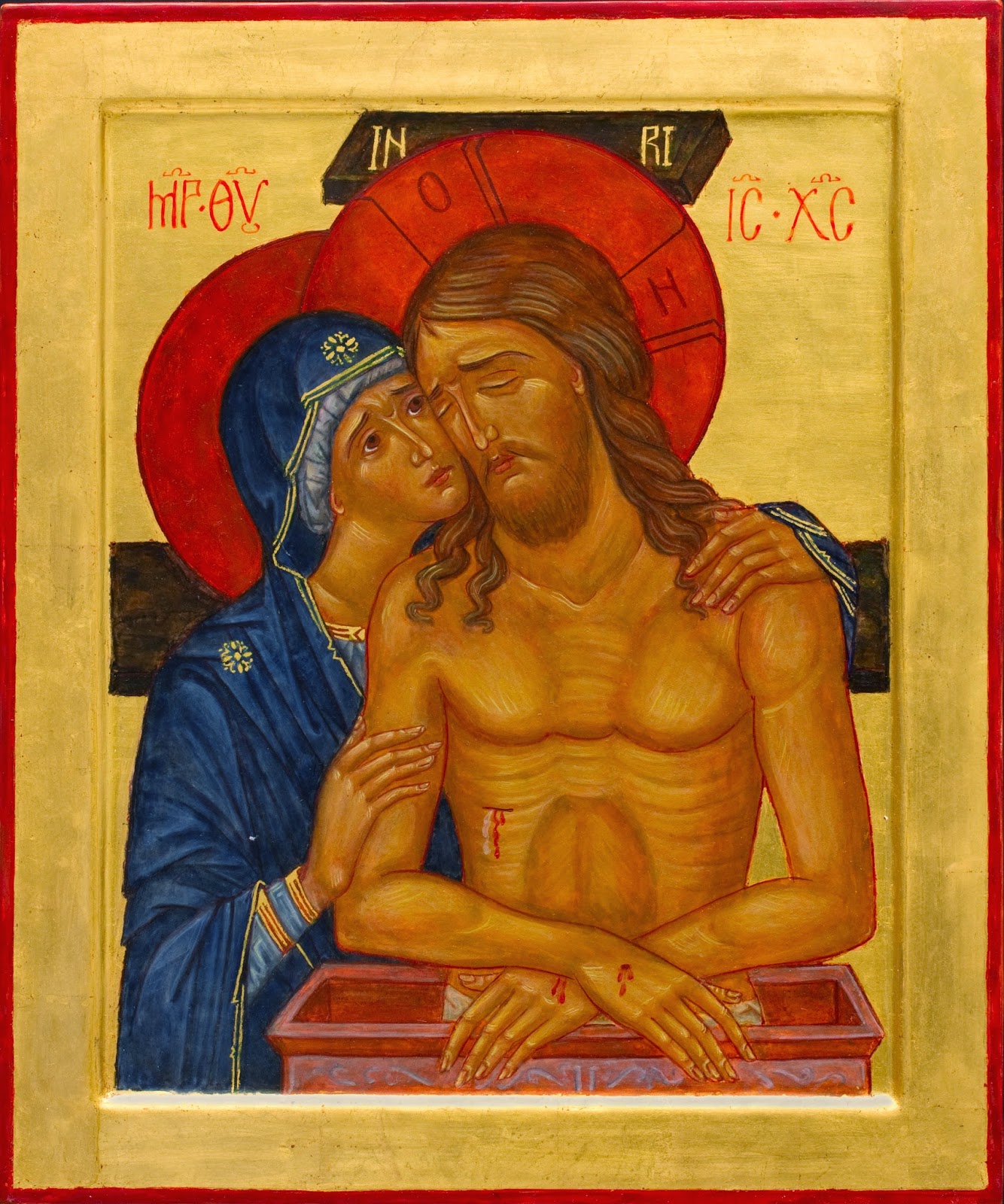
Today Christians remember the Lord's passion.   Our Lenten journey has reached its climax and the atmosphere becomes drier and more desolate.  Now even the bells at the monastery stop.  There are only clappers summoning us to prayer.  The Lord is no longer in the sanctuary.  There is an emptiness that pervades all the buildings. Our prayer sounds hollow in a church where the tabernacle has been abandoned by the Lord's Holy Presence.  Perhaps nothing so dramatically testifies to the validity of that Real Presence as when It is removed.

Later this afternoon we will participate in the Passion of Christ.  As a community we reenact the betrayal, trial, torture, and crucifixion of Jesus of Nazareth.  Every year, we go through this ritual and rightly attest to and atone for the collective human evil that crucified the Son of God - the Son of Mary - the righteous one who was without sin.  However even in the midst of this, we will venerate the cross with bows, prostrations, and kisses.  Why?  Because it is through this cross that the salvation of the world is secured.  Jesus suffered and died so that we could be united to His Abba, His God and our God.

This year, I hear Jesus say all the more louder, "Do not weep for me; weep instead for yourselves and for your children..."  So I ask, "Do we weep for ourselves, the world,  and the children?" Even though we as Christians affirm that the victory is already won and Satan has been vanquished, evil still seems to dominates the world and remains in our fears, doubts, prejudices, and hardheartedness.   Daily we are battered with news of atrocities, wars, and poverty - yet it does not penetrate a thick skin of what Pope Francis has termed "global indifference." A collective numbness holds back our tears. Do we want to look the other way and pretend none of this exists or that it only existed in 1st century Palestine.  Perhaps all this messiness is something we can project on certain nations or ethnic groups so as not to impugn our high tech post modern liberal rational society.

But Jesus doesn't let us off the hook.  "No," He says to the professional mourners - "do not weep for me, weep for yourselves and your children." Perhaps he is also saying, "Be converted.  Look to yourself.  There is no gloss that can hide the hypocrisy of the heart. Do not lament my death while refusing to recognize the systemic disease of a society where efficiency trumps love, materialism triumphs over human dignity, and superficiality silences truth.  I die so that you may Live."

Let us try to live this life that Jesus has given us and not cower in fear and indifference, but accept that we can make a difference.  Our deeds do not have to be great: just every day small acts of hope, courage, and self sacrifice that contribute to the building up of what is generous and noble in the human heart.

Sr Suzanne

Thursday, May 1, 2014

A Redwoods Immersion


The Ignatian Center of Santa Clara University, as part of the mission of the Jesuit Higher Education, sponsors Immersion experiences for students to places with special needs.  Santa Clara's website explains the purpose of Immersions:

 “These mutually enriching programs provide students with the opportunity to experience different cultures and diverse socioeconomic environments and to witness firsthand the challenges faced by marginalized communities.”

Usually places such as the inner city and poorer parts of world are chosen to host the students.  Last March, Santa Clara tried a new kind of Immersion and sent 10 students and 2 team leaders to Redwoods Monastery: a very different kind of marginalized community with a very unique culture (Cistercian monasticism based on the Rule of St Benedict) and an interesting socioeconomic environment. (We live by the work of our hands and own no property.)

The sisters at Redwoods entered this project in faith and not without some trepidation.  We knew that the students were both men and women between the ages of 19 and 22, representing variety of cultures and a wide range of backgrounds, interests and academic disciplines.  Some majored in biology, math or engineering;  others in computer science, theology or political science.

But the students were not unprepared for monastic life.  They had spent months before hand with staff at the Ignatian Center learning about monastic and church history, monastic practices and prayer.  By the time they arrived at Redwoods, they constituted a well-formed community ready for their week immersion experience.

One of the first group activities was a tour of the monastery.  Sr Claire and I lead the tour and pointed out a redwood with a ten foot long scar across its trunk. I told them the story of how the previous owner of the property, Bob Usher, had saved this redwood tree in the late 1940's.  As he was driving by one day, he heard the loggers sawing and told them to stop - that he was buying the property.  Bob a lover of trees and God eventually gave the property to the sisters for the construction of the monastery.  On hearing this story, one of the students said, "I feel like hugging this tree.  Let's all do it."  And so began the Immersion…

This image of 12 young people, connected, hugging an ancient tree (1600 years old) became icon for the Immersion. The redwood would have been a small seedling when the first monasteries were built in the West and later a towering tree when St Benedict wrote his Rule.  And now in the 21st century, these young people were open and enthusiastic, embracing a tradition centuries old just like they embraced the redwood.

The week of Immersion was marked by a somewhat rigorous monastic schedule of early rising, prayer and meditation, liturgy of the hours, lectio, conferences, work and meals.  In choir our voices soon blended into a steady and full stream of chant as the liturgy of the hours provided the basic structure of our day and the rhythm of our prayer and our community life.  Our guests arrived to choir on time and participated fully at each 6 hours of prayer.  No small task, even for seasoned monastics!

Lectio divina (close and prayerful reading of scripture) was done in common after breakfast for an hour.  Later in the morning, conferences were given by the sisters and the Immersion staff. One of the most impressive aspects of these students was their ability to read scripture with an open heart and cut to the meaning of the passage, applying it to their personal experience.

In the afternoon, the students tried their hand at manual labor done mostly in silence.  There were some very impressive and dedicated gardeners among them who helped Sr Ann Marie with weeding and vegetable bed preparation.  Others spent their time in the kitchen, diligently cracking nuts with Sr Victoria.  Another group worked in the redwood grove collecting fallen limbs and trimming huckleberry bushes while enjoying the beauty of these ancient giants.  Finally, a group of young men cleaned hard to reach places in our monastery.

 Was the week of Immersion beneficial?  Absolutely.  For that week, the size of our monastery doubled.  We were exposed en masse to a group of young people who were remarkably responsive and accepting of our way of life.  They seemed to naturally fall into the rhythm of monastic life without losing their spontaneity or zest for life.  It gave us hope that monasticism can still be meaningful to a new generation of adults.

The students also seemed to benefit from the Immersion.  Before they left Redwoods, they told the sisters about what affected them most during their stay.  Some spoke of their personal experience deepening in prayer or meditation and self-knowledge.  Others felt that the Immersion helped them to reevaluate important relationships.  They also discovered that being alone and being with oneself was not "lonely" but made them calmer and more self-assured. Without cell phones, internet and school and social pressures they experienced “rest.” (In the monastic tradition this is known as “quies.”)  Jowy, a musician in the group, reflected that without rests, there could be no music.


The importance of the Immersion was its reciprocity. Both groups, the sisters and the students, grew from the encounter and the embrace.  We accepted each other and formed a unique ecclesia in the Redwoods.