Showing posts with label Liturgy. Show all posts

Monday, October 2, 2017

THE HOLY GUARDIAN ANGELS

Readings of the day: RB 7:35-43
Mass: Exodus 23:20-23; Resp. Psalm 91 or Zechariah 8:1-8; Resp. Psalm 102;
Matthew 18:1-5,10


Bless the Lord, all you angels, you ministers, who do his will.
Alleluia, Alleluia.


The Directory on Popular Piety and the Liturgy provides insight into today’s celebration: 

“Devotion to the Holy Angels gives rise to a certain form of the Christian life which is characterized by:

  • devout gratitude to God for having placed these heavenly spirits of great sanctity and dignity [at our service];

  • an attitude of devotion deriving from the knowledge of living constantly in the presence of the Holy Angels of God; serenity and confidence in facing difficulties situations, since the Lord guides and protects the faithful in the way of justice through the ministry of His Holy Angels” (216).

In the presence of the angels I will sing your praises, Lord.
Psalm 137

ANGEL OF GOD,
my guardian dear,
To whom God’s love commits me here;
Ever this (day, night) be at my side,
To light and guard, to rule and guide.
Amen.


Saturday, September 23, 2017

SAINT PIUS OF PEITRELCINA

Readings of the day: RB 5:14-19
Mass: 1 Timothy 6:13-16; Resp. Psalm 100; Luke 8:4-15

Today I remember a dear friend, mentor, and teacher, Father Paschal Cheline, OSB (1936-2015), who inculcated me with a love of and reverence for all things liturgical. In one of his classes, Fr Paschal offered a definition of liturgy: “The celebration of the presence of Jesus Christ the Lord among us in signs.” He also gave his students the definition taught him by his friend and confrere, Abbot Bonaventure Zerr, OSB (1936-1988). Abbot Bonaventure defined liturgy as Psalm 100, today’s Responsorial Psalm.

Psalm 100
Padre Pio

Make a joyful noise to the Lord, all the earth.
Worship the Lord with gladness;
come into his presence with singing.

Know that the Lord is God.
It is he who made us, and we are his;
we are his people, and the sheep of
his pasture.

Enter his gates with thanksgiving,
and his courts with praise.
Give thanks to him, bless his name.

For the Lord is good; his steadfast love endures forever,
and his faithfulness to all generations.


Lord Jesus Christ, Son of the Living God, as we celebrate the Holy Eucharist, “the source and summit of the whole Christian life” (Lumen Gentium, 11), grant us the grace to worship you with gladness and thanksgiving; with praise, singing joyful songs to the Lord. 

PADRE PIO, SAINT PASCHAL BAYLON, SAINT BONAVENTURE, PRAY FOR US.

Friday, September 8, 2017

FEAST OF THE NATIVITY OF THE BLESSED VIRGIN MARY


Readings of the day: RB 1:1-5; Micah 5:1-4a or Romans 8:28-30; Resp. Psalm 13/Is 61:10; Matthew 1:1-16,18-23

Holy Mary, of her was born Jesus who is called the Christ. His greatness shall reach to the ends of the earth; he shall be peace. We contemplate the gift.

Let us celebrate with joy the Nativity of the Blessed Virgin Mary, for from her arose the sun of justice, Christ our God. (Entrance Antiphon, Mass)

MARY, CAUSE OF OUR JOY, PRAY FOR US.

Friday, April 3, 2015

Do Not Mourn for Me


A large crowd of people followed Jesus, including many women who mourned and lamented him. Jesus turned to them and said, “Daughters of Jerusalem, do not weep for me; weep instead for yourselves and for your children... (Luke 23:27-27)

Good Friday, 2015

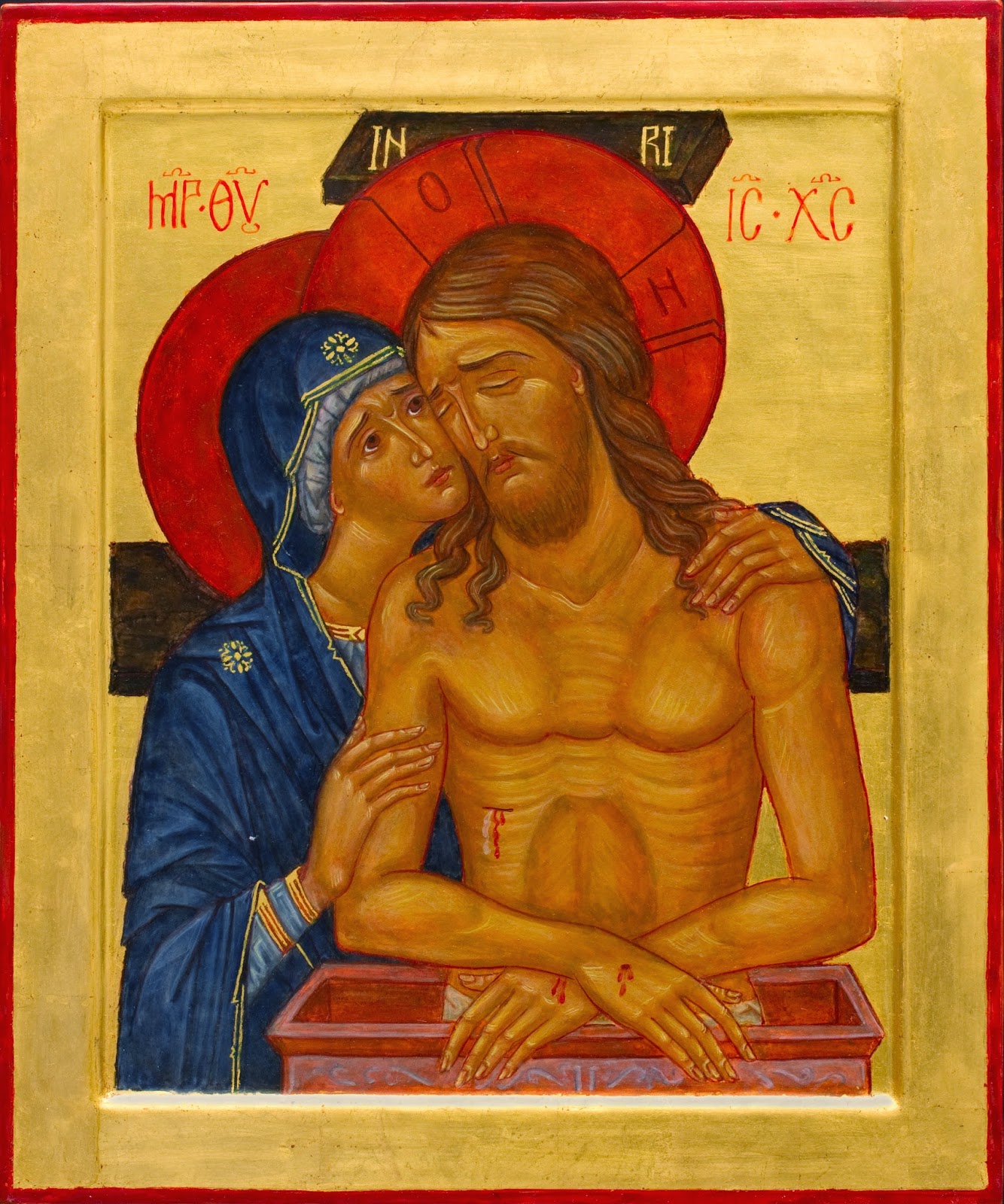
Today Christians remember the Lord's passion.   Our Lenten journey has reached its climax and the atmosphere becomes drier and more desolate.  Now even the bells at the monastery stop.  There are only clappers summoning us to prayer.  The Lord is no longer in the sanctuary.  There is an emptiness that pervades all the buildings. Our prayer sounds hollow in a church where the tabernacle has been abandoned by the Lord's Holy Presence.  Perhaps nothing so dramatically testifies to the validity of that Real Presence as when It is removed.

Later this afternoon we will participate in the Passion of Christ.  As a community we reenact the betrayal, trial, torture, and crucifixion of Jesus of Nazareth.  Every year, we go through this ritual and rightly attest to and atone for the collective human evil that crucified the Son of God - the Son of Mary - the righteous one who was without sin.  However even in the midst of this, we will venerate the cross with bows, prostrations, and kisses.  Why?  Because it is through this cross that the salvation of the world is secured.  Jesus suffered and died so that we could be united to His Abba, His God and our God.

This year, I hear Jesus say all the more louder, "Do not weep for me; weep instead for yourselves and for your children..."  So I ask, "Do we weep for ourselves, the world,  and the children?" Even though we as Christians affirm that the victory is already won and Satan has been vanquished, evil still seems to dominates the world and remains in our fears, doubts, prejudices, and hardheartedness.   Daily we are battered with news of atrocities, wars, and poverty - yet it does not penetrate a thick skin of what Pope Francis has termed "global indifference." A collective numbness holds back our tears. Do we want to look the other way and pretend none of this exists or that it only existed in 1st century Palestine.  Perhaps all this messiness is something we can project on certain nations or ethnic groups so as not to impugn our high tech post modern liberal rational society.

But Jesus doesn't let us off the hook.  "No," He says to the professional mourners - "do not weep for me, weep for yourselves and your children." Perhaps he is also saying, "Be converted.  Look to yourself.  There is no gloss that can hide the hypocrisy of the heart. Do not lament my death while refusing to recognize the systemic disease of a society where efficiency trumps love, materialism triumphs over human dignity, and superficiality silences truth.  I die so that you may Live."

Let us try to live this life that Jesus has given us and not cower in fear and indifference, but accept that we can make a difference.  Our deeds do not have to be great: just every day small acts of hope, courage, and self sacrifice that contribute to the building up of what is generous and noble in the human heart.

Sr Suzanne

Thursday, March 28, 2013

How Do We Serve

Pope Francis is a man who is leading his Church by example.  Today he is holding Holy Thursday services at a prison for juveniles on the outskirts of Rome.  He showing us how to serve the marginalized, the poor, those shunned and feared by society.  He has told us this week that we are not to be a complacent 99% but rather extend a hand and a heart to the most vulnerable and disenfranchised.  Live Christ's Gospel of love not only in the Church or Monastery, but in the world. With that message of love we enter these most sacred days of the Church calendar.

At Redwoods we began the Triduum with a chapter talk by Sr Kathy, Abbess.  She emphasized the importance of our images of God; how they influence our relationships with one another and even extend into the world. The liturgy today exposes a radical new view of a "God with us." It is Christ who feeds us with his body and blood and washes our feet in personal service.
Hear the entire Holy Thursday message:

Thursday, February 23, 2012

Candlemas at Redwoods

Watch highlights of our liturgical celebration of the Feast of the Presentation, celebrated on February 2.  It is a feast that commemorates Mary and Joseph bringing Jesus to the Temple for the Rite of Purification in accordance with the Law of Moses.  At the Temple, Christ is recognized by the Simeon and Anna.  The Song of Simeon (Luke 2:22-35 ) is  often sung at Compline, the last Office of prayer of the day.  "And now Lord, you may let your servant go in peace for with my own eyes I have seen your salvation." We like Simeon and Anna wait for the Lord, the light of the nations.

Friday, April 8, 2011

T'he School of Jesus

Lent is a journey, it means accompanying Jesus who goes up to Jerusalem, the place of the fulfilment of his mystery of Passion, death and Resurrection; it reminds us that Christian life is a “way” to take, not so much consistent with a law to observe as with the very Person of Christ, to encounter, to welcome, to follow.  Benedict XVI, Ash Wednesday Address
In his Ash Wednesday address, Pope Benedict goes on to explain the importance of Liturgy as a means to make present the life, death, and resurrection of Jesus.  He calls the liturgy "the School of Jesus," where "Christ makes himself present through the power of the Holy Spirit and these saving events become real."

This same power and presence is the foundation of the monastic Liturgy of the Hours.  At Vigils, we keep watch for the Messiah in all His comings - Past - Present - Future.  The psalms we recite recall the longings of ancient Israel.  In prayer and meditation, we commune with His presence in our hearts.  And we stay awake so that we may be ready for His return.

With the dawn (Lauds), we greet the rising of the sun and celebrate the arrival of the Savior by singing the Canticle of Zachary (Benedictus):which describes the loving kindness of the heart of God as "a dawn from on high."  During the prayer at noon (Sext or Midday) we chant the psalms of ascent.  These are ancient psalms that have been sung by Jewish pilgrims as they go up to Jerusalem to celebrate festivals. At evening prayer (Vespers), we sing with Mary, the Mother of God, her Magnificat and recount God's mercy and plan of salvation.

At Compline, the day is complete.  We end the prayer with a blessing from the Abbess and remember the words of Simeon, " Now Lord, you may let your servant go in peace, for with my own eyes, I have seen your salvation."

This is the rhythm of the Divine Office which forms us into monks and nuns.  During a liturgical season, such as Lent, prayers, hymns, readings, and antiphons become even more centered on Jesus and draw us deeper into His life.  A good example of this is a common Cistercian hymn often sung at noon prayer.  "The hour it is when Christ did thirst, for Justice thirsted on a tree.  His lips were slaked by no relief - except a poor man's psalm of grief."  The hymn works in us because it is noon, the time of day that tradition commemorates the beginning of Christ's passion.  It is Lent, we have been fasting and we are hungry and maybe a little thirsty. The liturgy invites us to unite our own experience, which has been structured by our monastic schedule, with the experience of Christ.  At the same time we are the monastic choir, singing psalms - so we also take on the role of the "poor man", the one who agonized with Christ at His hour of suffering.

As we come nearer to Holy Week, may we make time to experience this school of Jesus, attending liturgies not only in church but also in the prayer of the heart.  May the living Jesus touch us all very specially this Lent.